BlackBuck -Zinka Logistics· Design case study
GPS
Fulfillment.
I was tasked with designing the GPS portal to improve work efficiency. But I knew that simply
designing the UI wouldn't solve the real problem: scaling from 1000 to 4,000+ orders monthly while maintaining
same-day dispatch and team size. So I mapped the workflow first and discovered the actual
bottlenecks lived in the process, not the screen. My redesign addressed both—transforming
operations and the portal together to achieve the necessary scale.
ROLE · Product Designer
TIMELINE · May 2019
TEAM · PM + Eng Pod + Ops Stakeholders
DOMAIN · Truck Logistics
4x
Monthly orders processed(1,500 to 6,000, Sept -Nov 2019)
96%
Online pending time reduction (183h to 7h)
74%
Order in Delivered state reduced (624h to 162h)
00 /
Summary
Problem, intervention, and outcome at a glance.
Users: GPS Fulfilment Team
Problem
Growth exposed the breaking point: the GPS operations team couldn't track or fulfill orders reliably. Their existing processes had hidden these inefficiencies at smaller scale.
Intervention
Introduced features that eliminated physical bottlenecks in order fulfillment, dramatically accelerating processing speeds and reducing operational friction.
Outcome
Achieved 4x throughput, 96% faster pending resolution, and 74% faster delivery cycles—scaling orders from 1,000 to 4,000+ monthly without team expansion
01 / Ownership matrix
What I personally owned vs what I partnered on.
Every great project requires deep collaboration. I believe the most valuable work comes from asking the right questions—even the uncomfortable ones—to uncover hidden requirements and align stakeholders around shared goals
Problem
Discovery
IA + flow
Interaction + UI
Content
I owned
Research framing, synthesis
Information model and navigation hierarchy
Core Features, prioritization behavior, state handling
Initial Content and Terminology Capture
Partnered with
PM
Users
Visual Designer
Content Designer to Finalize
02 / Research Methodology
I started by understanding how the OPS team actually works day-to-day.
The OPS team is responsible for moving customer orders from request to activation while coordinating across Customer,systems.
I did informal user interviews and user shadowing. Thos
Research Methodology
I interviewed the operations team and their lead to understand
their workflows and methods. Then I shadowed them for couple
of days, observing firsthand the challenges they faced during
actual work. This dual approach—talking through processes and
witnessing them in action—revealed gaps that
interviews alone wouldn't have surfaced.
OPS team in BlackBuck

This insight became the blueprint for designing solutions that actually solved the problem.
03 / Journey Mapping
Mapped what slowed operators down and why those delays compounded.
The team had no formal role designations—instead, members rotated between four task-based roles as the team lead directed. This fluidity, while seemingly flexible, actually created problems: inconsistent execution, unclear ownership, and difficulty building specialized knowledge or process improvements.
I combined stakeholder interviews and shadowing to map the user journey, then conducted operational walkthroughs to pinpoint the most frequent friction points.

Responsibilities
Role 1
2-3 members
Contact truck owners with GPS device bookings to confirm their delivery address.
Review truck owner documents to identify and correct data entry errors.
Scan the GPS device code and link it to the corresponding customer.
Role 2
1 member
Create parcel dockets for verified users and confirm address and contact details match.
Verify that the GPS device voltage rating matches the truck's battery voltage rating.
Role 3
1 - 2 members
Ensure all parcels reach their intended delivery location.
Update the delivery address if any discrepancies are identified.
Role 4
2 - 3 members
Contact the customer and schedule the installation.
Contact the installation partner and agree on a suitable time slot for device installation.
Ensure truck and GPS device alignment across multiple orders from the same customer.
Activate the device and perform final checks.
"We know orders are stuck, but we cannot tell which one needs intervention first."
Field photos documenting operational workflows and pain points observed during team shadowing sessions.

Pending task tracking via sticky notes

Serial numbers are manually typed into the system for each device.

GPS device types must match truck battery voltage.

Third-party lead management system

Operators handle back-to-back customer calls.
These issues informed the complete research synthesis.
04 / Research Sythesis
Surfaced pain points across three perspectives:
Software, OPS team, and Customers.
Displaying only the important findings aligned with project scope.
Software Issue
No specific software applications available
Data for the next process stage is updated into a shared excel sheet used by the group.
They use multiple software tools to complete each stage.
Significant effort is required to transfer data from one software to another.
Orders are received through a third-party portal customized for our requirements.
Whenever data transfer occurs, a team member must ensure that no data loss happens.
The team lead lacks an overall view of work in progress.
The current software does not track edits made at any stage.
Difficulties faced by Team Member
They spend continuous time on the phone.
They receive return calls from customers sometimes after hours and cannot recall who is calling.
Customers are highly demanding and require continuous handholding support.
They cannot capture customer feedback during calls and usually note it on paper or sticky notes.
Entering device details from package to system is manual; users must type in all device ID numbers.
One person performs the GPS entry process and can process a maximum of 80 devices daily.
When a device fails at installation, they must coordinate with the customer and delivery person multiple times.
GPS devices must match the truck's battery, complicating coordination to find the correct device.
Difficulties faced by Customer
Conversations between team members and customers lack professionalism with no way to track performance.
They must explain repeatedly to each team member why they are calling and the reason for their call.
Coordinating with the installation electrician and GPS ops team is quite hectic.
Sometimes the installation person refuses to visit the truck location if it is too far away.
The installation manual in the GPS box is unhelpful because it is in English, while both the truck owner and installer speak only local languages.
Most delay sat between stages, not within stages. Handoffs were the real bottleneck.
To make these insights actionable, I translated them into structured research artifacts.
05 / Emotion Journey map
I mapped emotional pressure
Emotion journey maps guide where to invest design effort by identifying which features will reduce emotional friction most, while validating that you've solved the real problem rather than just surface symptoms.
Low points = redesign to reduce friction, Neutral points = streamline or add delight, High points = maintain and reinforce,

06 / Affinity Themes
Grouped findings into six recurring problem themes.
Each theme appeared repeatedly across software, team operations, and customer-facing interactions.
Tool fragmentation
Multiple tools and third-party portals per journev.
• Excel used as a bridge between systems.
• No unified operational view
Manual data movement
Frequent copy-paste between stages.
Manual entry of device details.
High risk of data loss during transfer.
Communication overload
Heavy dependence on calls and callbacks.
Customer context not retained consistently.
Follow-ups rely on memory.
Weak knowledge capture
Feedback stored in diaries/sticky notes.
No structured tracking of outcomes.
Low reuse of learning across cases.
Capacity bottlenecks
Single-person dependency in critical tasks.
Manual throughput limits.
Delays propagate when one step stalls.
Install coordination friction
Difficult alignment across customer, installer, delivery.
Location and compatibility constraints.
Repeated re-coordination.
I reframed the design challenge around operational clarity—aiming to improve flow reliability, ownership visibility, and decision velocity.
07 / Final product proposal
I proposed an operational model centered on real-time visibility and clear ownership—enabling faster decision-making and reduced friction.
Based on deep operational research and process analysis, I identified four critical features to optimize the fulfillment workflow:
Unified Operations Dashboard
Provides all stakeholders with real-time visibility into order status at every stage
Tracks ownership and responsibility for all changes and customer feedback (RBAC)
Designed in consultation with product and leadership teams to balance visibility with Dev effort
Enables quick order state searches through advanced filtering capabilities
Integrated Internal Communication Tool
Replaces fragmented personal SIM card usage with a centralized calling system
Automatically logs all customer conversations for quality assurance and performance tracking
Pre-populates caller details from previous interactions, eliminating repetitive information gathering
Structured Feedback Capture
Systematizes feedback collection currently lost across manual notes and sticky notes
Captures customer requirements at each touchpoint (typically 4-5 interactions per order)
Tags all feedback to orders for continuous process improvement and historical context
Barcode Scanning for Device Registration
Eliminates time-consuming manual serial number entry through barcode scanning
Reduces data entry errors and accelerates device registration workflow
After aligning on the proposal, I translated these ideas into the final feature set and UI screens.
08 / Final features and screens
Organized final design around key moments in the OPS journey.
Features designed to bridge operational gaps between digital and manual workflows.
Product stage

Navigation tabs mirror organizational roles—reducing cognitive load by aligning UI structure with existing workflows.
GPS Dashboard - Confirmation Pending
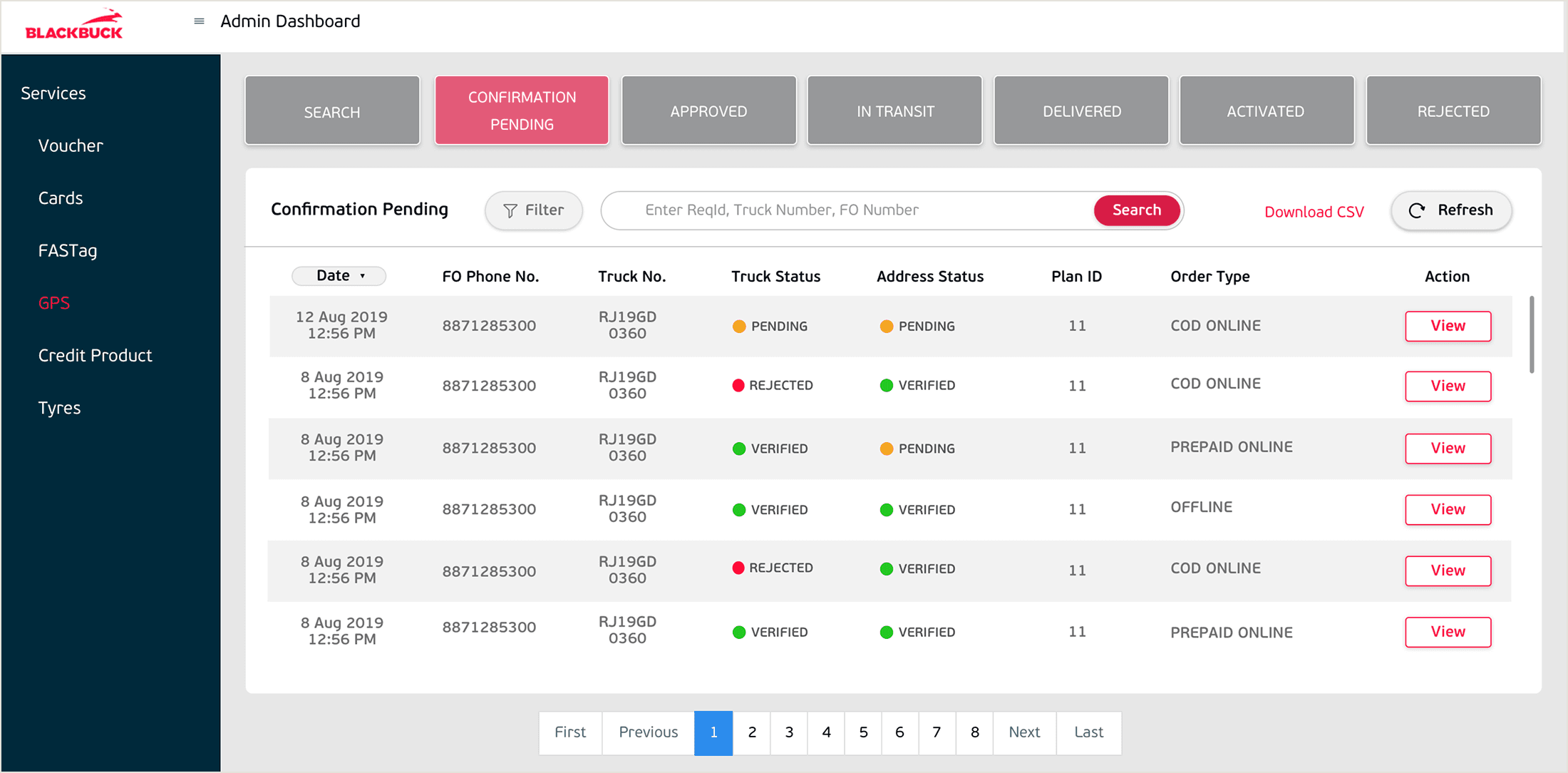
The flow mirrors real-world order verification. Users access order details, identify pending items requiring verification, and confirm—all within a single cohesive workflow
Feedback Capturing

Log conversation details in the status field.

Research revealed four primary statuses: Not Reachable, Call Back, Not Available, and No Response (RNR)."

Team members see conversation history from previous interactions—providing context on the last FO engagement before taking action.
Easy Filter Options
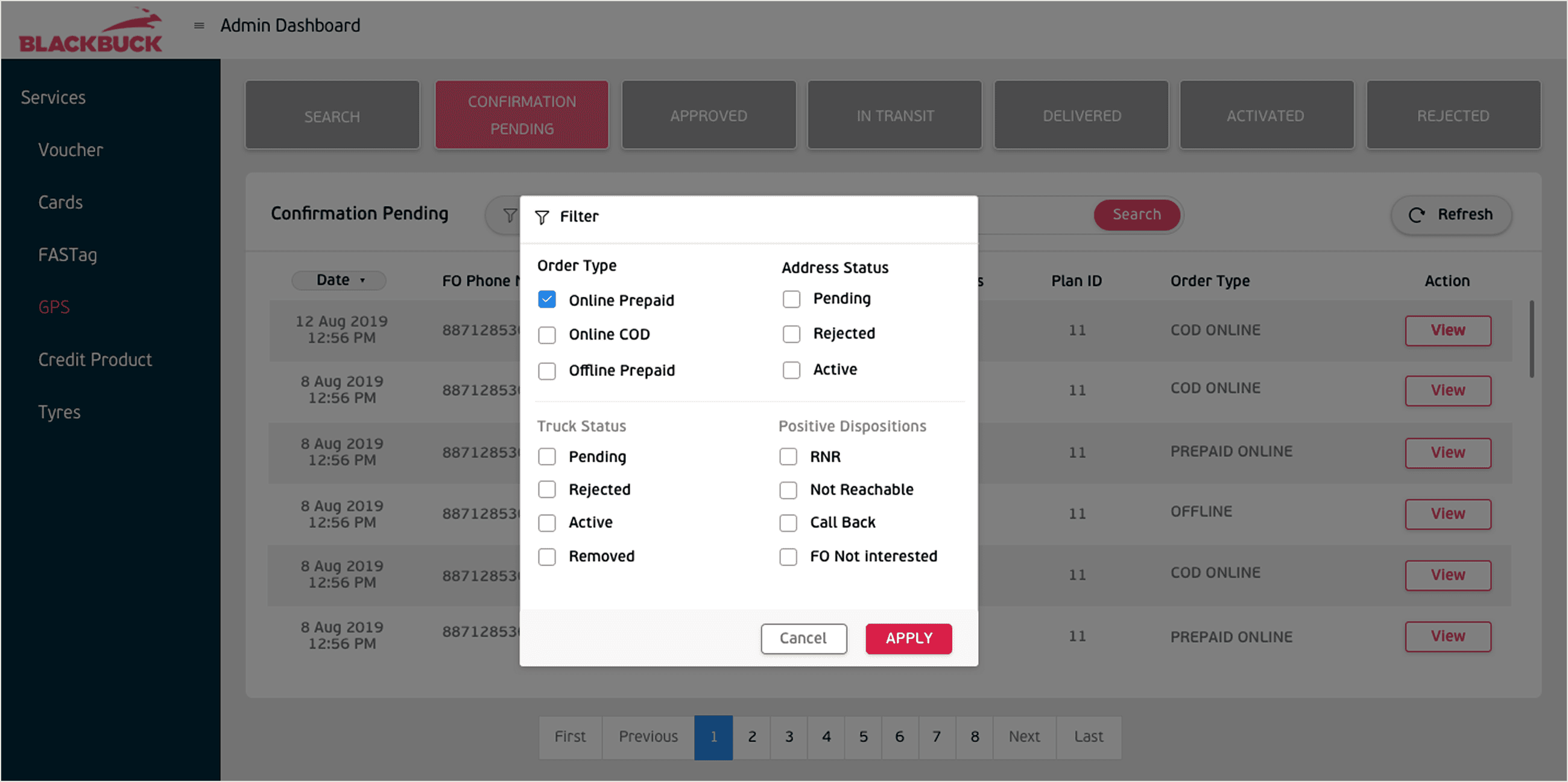
Multi-parameter filtering for faster insights
Tracking Stage
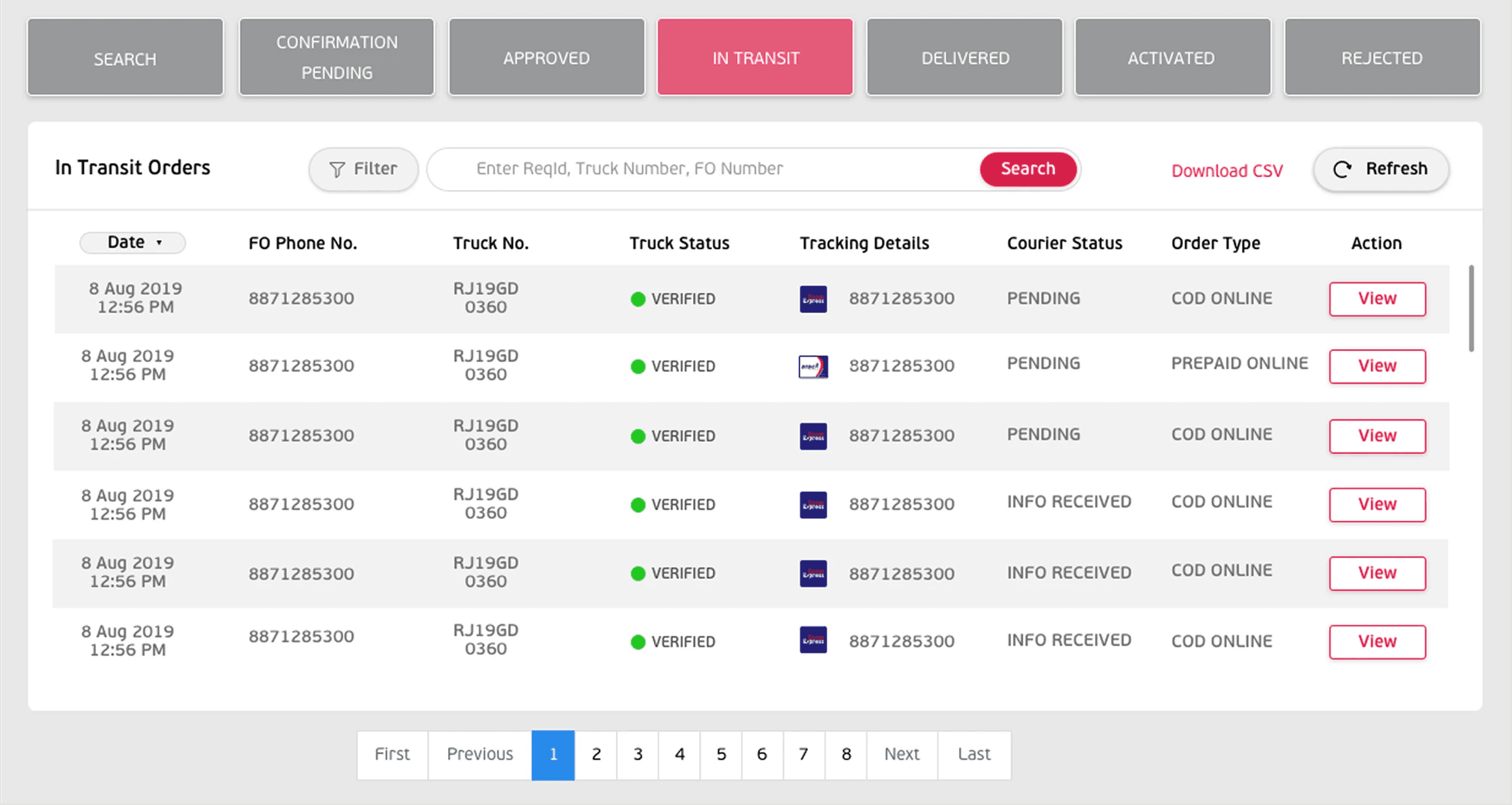
Real-time visibility into where each order stands in the workflow
Scan

At the requested stage, users can click the scan button to activate the linked device and capture QR codes—enabling rapid order verification without manual entry
Call Option Feature

Integrated call initiation protects team privacy—calls route through the portal, eliminating the need to share personal phone numbers.

Call quality tracking enables targeted coaching—identifying operators who need support and improving overall service delivery
09 / What is the impact
I measured impact at operational, team, and customer levels.
This deep-dive explains not just what changed, but why the changes mattered to the business and users.
4x
Monthly orders processed(1,500 to 6,000,
Sept -Nov 2019)
96%
Online pending time reduction
(183h to 7h)
74%
Order in Delivered state reduced
(624h to 162h)
Operational impact
Order throughput improved from 1,500 to 6,000 per month.
Pending-state turnaround dropped from 183h to 7h.
Delivery cycle reduced from 624h to 162h.
Team impact
OPS team shifted from status hunting to issue resolution
Manager-agent collaboration improved with shared visibility.
Escalations became earlier and more targeted
Customer impact
Faster activation improved customer confidence and trust.
Reduced delays lowered follow-up uncertainty.
Clearer service progression improved experience quality.
Beyond outcomes, this project sharpened how I approach enterprise workflow design under operational pressure.
10 / What this project has taught me
I learned that visibility is a product capability, not a dashboard feature.
This project reinforced the habits I now carry into every large-scale operations redesign.
Design lessons I carry forward
Map handoffs first; bottlenecks often live between teams, not within tasks.
Prioritize action hierarchy over information completeness.
Use journey + emotion mapping to align stakeholders on where interventions matter most.
What I would do differently next time
Define telemetry and success signals earlier in discovery.
Field visit to understand how the FO is impacted. And design experience from their end to smoothen the overall experience.
10 / Closing reflection
This project changed how I think about design impact.
A short reflection on what this experience taught me as a lead/Sole designer.
This project taught me that operational design succeeds or fails on one thing: whether people can see the right problem early enough to act. The breakthrough was not adding more screens, but redesigning how information moved across teams so bottlenecks became visible, shared, and actionable. Watching the OPS team shift from reactive firefighting to confident decision-making was the strongest proof that the work was effective.
Personally, this case sharpened how I lead under complexity. I learned to frame ambiguity faster, align stakeholders around evidence instead of opinions, and turn research into systems that scale beyond a single feature. If I carried one lesson forward, it is this: in high-stakes workflows, great UX is not polish — it is operational clarity that changes outcomes.
09 / How I would redesign with AI in 2026
I would keep the workflow, and add AI at the friction points that caused the most delay.
If I relook this product today, I would focus AI on verification, customer back-and-forth communication, and installation coordination while keeping humans in control of critical decisions.
AI for verification speed
Document pre-checks to detect missing fields, mismatches, and low-quality uploads at intake.
Risk score to flag orders likely to stall before they enter pending loops.
Agent copilot suggesting next best action with reason and confidence.
AI for communication clarity
Auto-generated status updates tailored to the customer's current stage.
Smart missing-information prompts that ask for exactly what is required.
Conversation summary for agents to reduce repeated questioning and handoff gaps.
AI for install coordination
Recommended installation slots based on availability, travel, and completion probability.
No-show and reschedule risk prediction with proactive re-confirmation.
Fallback recommendation when the assigned path is blocked.
What data I would use first
I would start with existing operational signals already generated by the workflow: stage timestamps, status transitions, document upload states, installer assignment and scheduling logs, and customer communication history. This allows AI support without waiting for a large platform rebuild.
Rollout approach (vision aligned to basic AI maturity)
Phase 1: decision-support AI only (human-in-loop for all critical actions).
Phase 2: automate low-risk actions like proactive status nudges.
Phase 3: optimize queue priorities and coordination recommendations continuously.
Beyond outcomes, this project sharpened how I approach enterprise workflow design under operational pressure.